Abstract
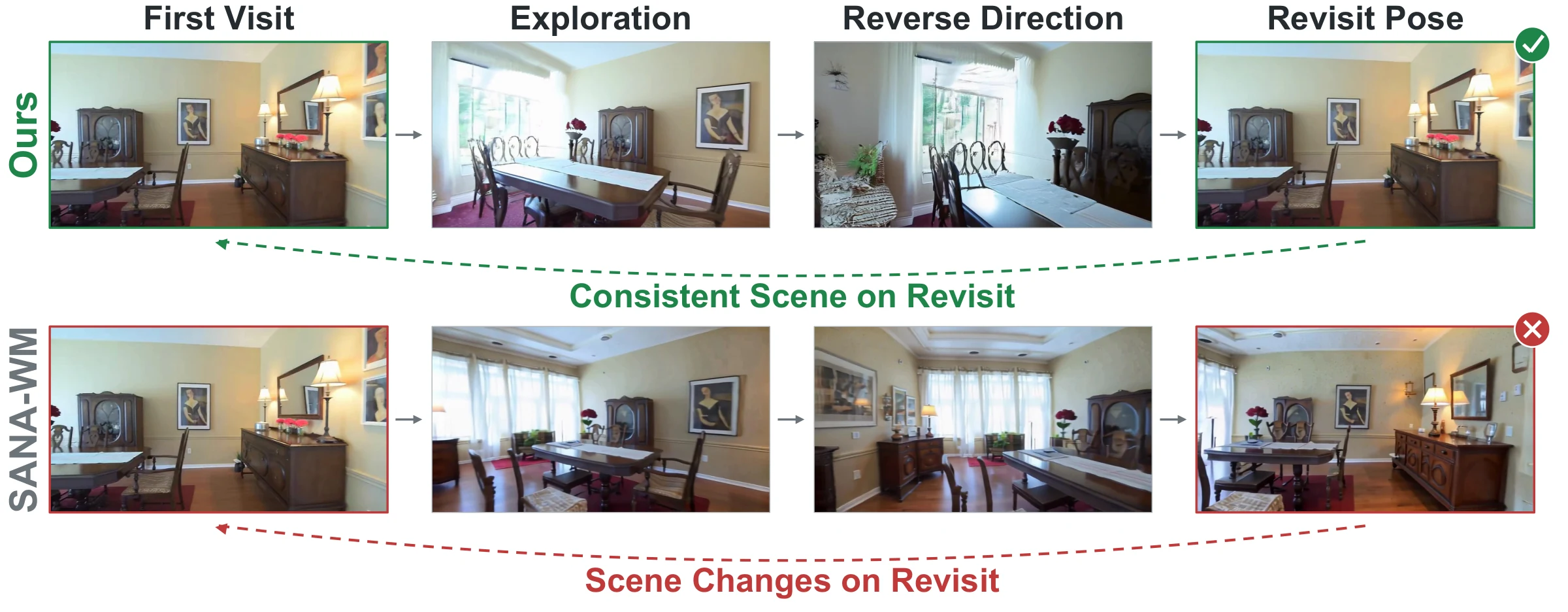
Recent advances in video world models have enabled plausible interactive environments, yet long-horizon generation places a fundamental demand on visual memory: the previously observed world must remain consistent as the model continues to generate. Existing autoregressive approaches often implicitly rely on the generative model itself to retain such information, making persistent scene memory difficult to maintain beyond the active context. We introduce World-T3, a camera-controlled video world model with a test-time training memory that consolidates past observations into dedicated model parameters. To robustly update this memory, we propose a recursive least-squares rule that incrementally absorbs novel visual features via online pose-keyed memory updates. Our TTT memory reads out previously observed scene features from the fast-weight state by camera pose, enabling consistent generation with constant storage and per-step computation regardless of rollout length. To facilitate real-time interactive generation with this robust memory, we further distill the autoregressive model into a few-step generator via dual-teacher distribution matching. On a long-horizon revisit benchmark, World-T3 raises revisit PSNR from 13.52 to 18.31 dB and reduces absolute rotation error from 3.344° to 1.075° relative to the strongest baseline on both metrics, while sustaining 20.6 FPS at 1280×704 on a single NVIDIA B200 GPU.
Out-and-Back Revisits
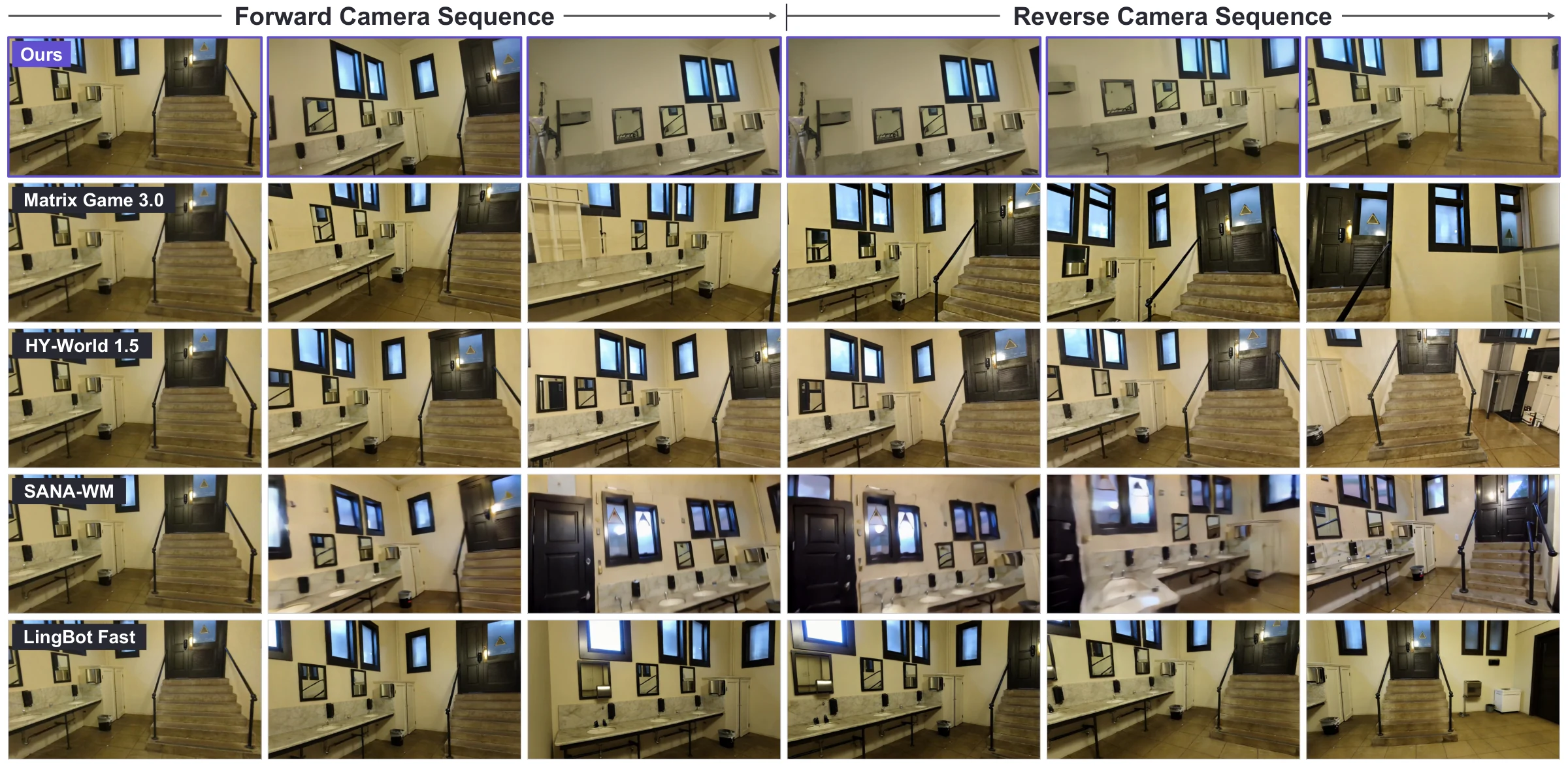
Each 10-second camera trajectory moves forward for 5 s, then retraces its path in reverse. A model with persistent memory should end on the same view it started from. All methods receive the same first frame, text prompt and camera trajectory.
Text prompt for this scene
Longer Generation with Revisits
Method
Starting from a pretrained text-image-to-video diffusion model, World-T3 is built in three progressive stages.
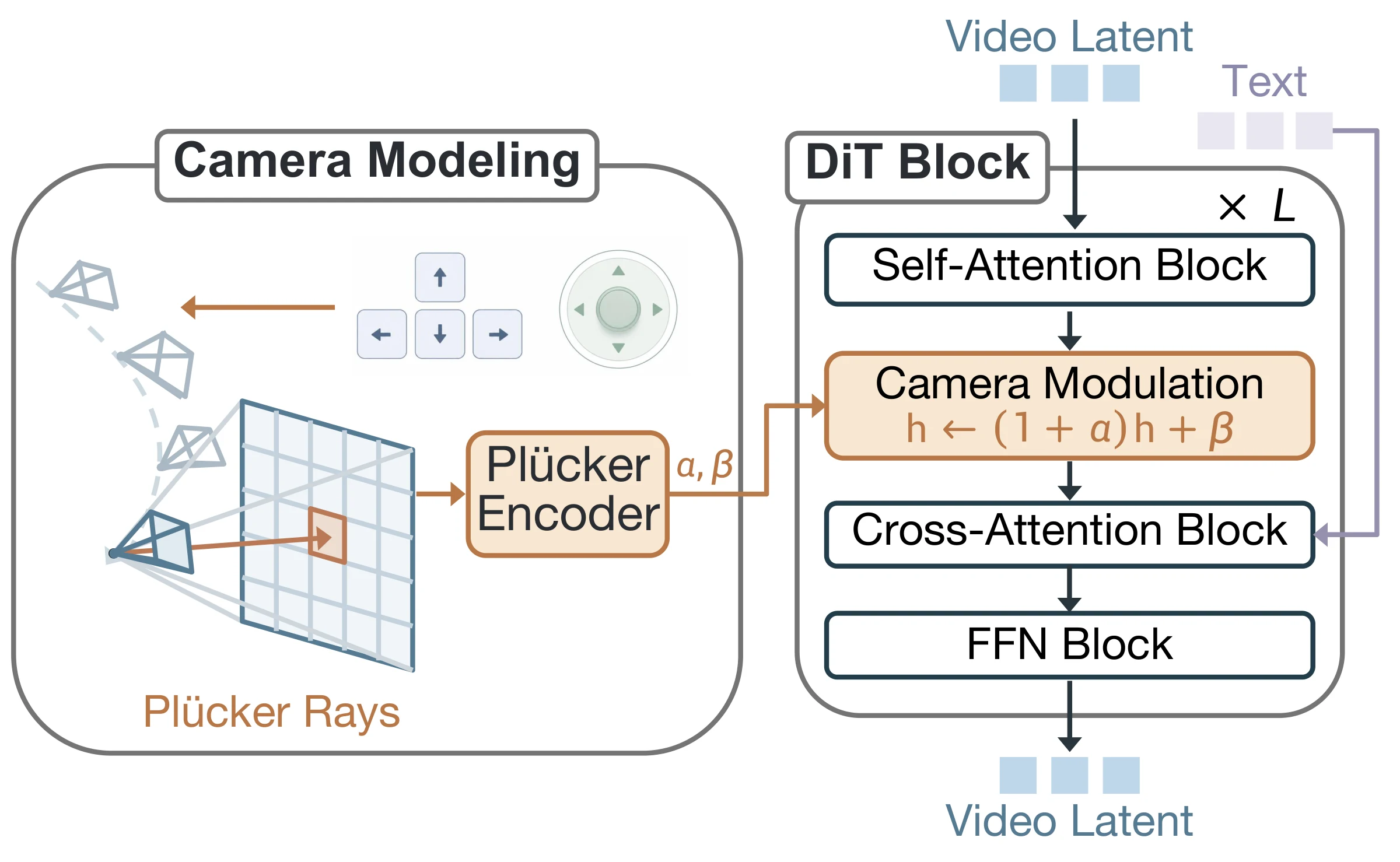
bounded context write to memory read / target block
few-step student bidirectional teacher / critic memory-augmented teacher / critic
Results
120 out-and-back clips (10 s, 1280×704, 16 FPS) from the test split. Revisit metrics pair outbound and return frames at the same requested pose, with all gaps beyond our 21-latent-frame context window.
Speed vs. quality
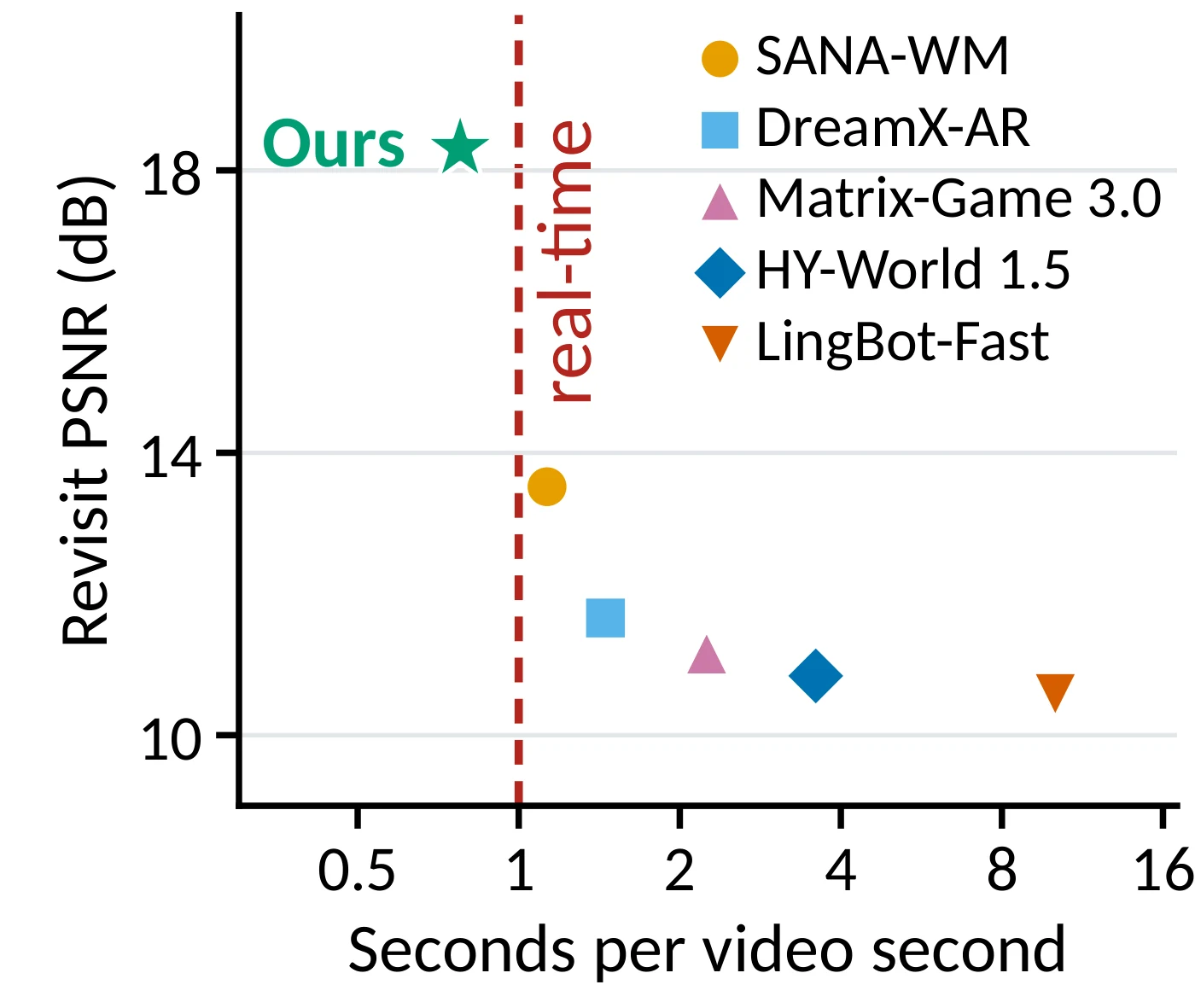
Comparison on the revisit set
| Method | Steps | Revisit ↑ | Camera ↓ | FPS ↑ | ||
|---|---|---|---|---|---|---|
| Sem. Sim. | PSNR | RotErr° | CamMC | |||
| Matrix-Game 3.0 | 3 | 0.8225 | 11.15 | 11.179 | 0.2958 | 7.1 |
| HY-World 1.5 | 4 | 0.8563 | 10.84 | 12.864 | 0.3484 | 4.5 |
| DreamX-AR | 4 | 0.8768 | 11.66 | 8.011 | 0.2276 | 11.0 |
| LingBot-Fast | 4 | 0.8580 | 10.59 | 9.817 | 0.2639 | 1.6 |
| SANA-WM | 4 | 0.9200 | 13.52 | 3.344 | 0.1200 | 14.2 |
| Ours (Stage 2) | 50 | 0.9476 | 16.69 | 1.308 | 0.0381 | 4.4 |
| Ours (Stage 3) | 4 | 0.9610 | 18.31 | 1.075 | 0.0318 | 20.6 |
Bold: best, underline: second best. Full table with VBench, RPE and peak memory in the paper.
Qualitative Comparison
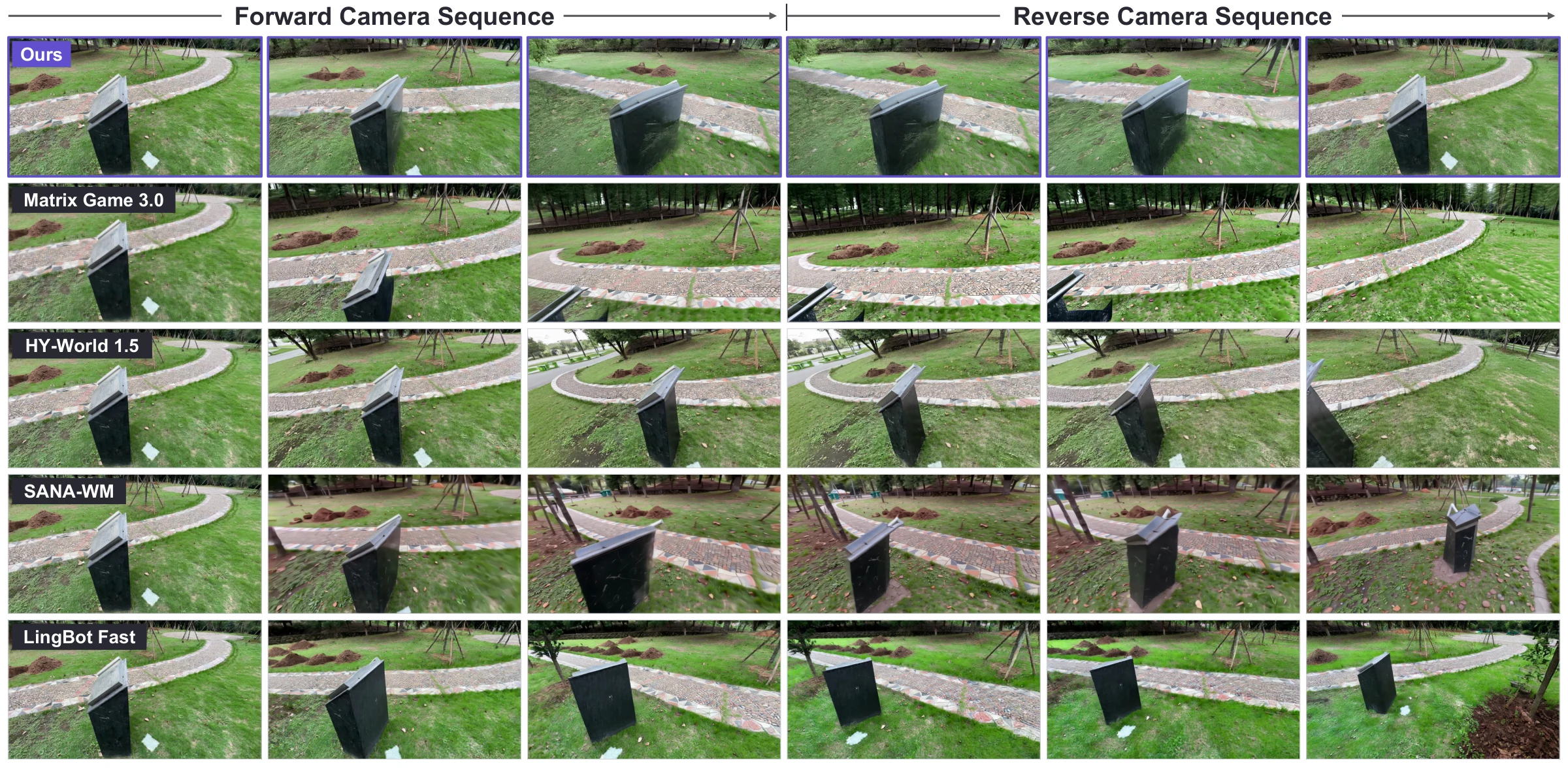
More Results
Keys on each clip show the camera motion its trajectory implies. Hover a clip for its camera path; click to open it large (← → to step through, Esc to close).
BibTeX
@article{wu2026worldt3,
  title   = {World-T$^3$: Test-Time Training as Persistent Memory for Real-Time Video World Models},
  author  = {Wu, Junyi and Li, Zekun and Yang, Chenhongyi and Guo, Chen and Yang, Lingchen and
             Zhang, Yongan and Zhang, Xinyi and Hu, Hongbing and Rymkowski, Bartek and
             Sridhar, Srinath and Yan, Yan and Huang, Xijie},
  journal = {arXiv preprint},
  year    = {2026}
}